Now Available: The Opportunity Zones Playbook

The Book on Opportunity Zone Investing

UPDATE June 6, 2026: There’s a brand new book on Opportunity Zone investing: The Opportunity Zones Playbook by Jimmy Atkinson is the definitive guide to one of the most powerful — and most misunderstood — strategies in the US tax code. Featuring a foreword by US Senator Tim Scott, the architect of the Opportunity Zones policy.
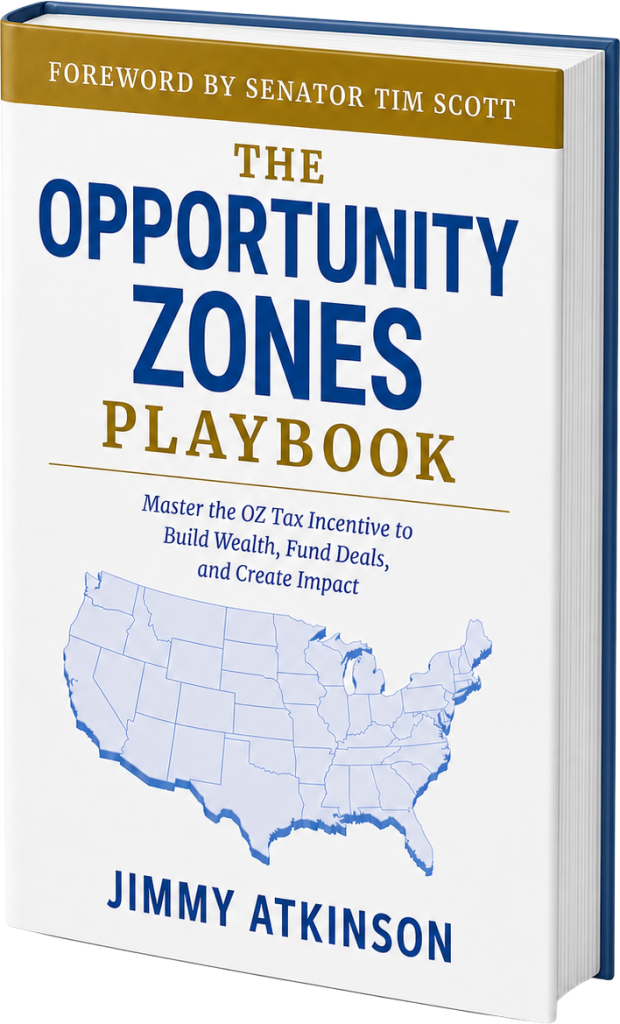
In this book, Jimmy Atkinson draws on nearly a decade of experience to translate the complexities of Opportunity Zone investing into clear, actionable strategy. Built on hundreds of interviews with fund managers, developers, attorneys, and CPAs, it’s a clear, practical guide for investors, sponsors, and the advisors who serve them.
This book is for real estate developers, GPs, fund managers, and capital raisers, attorneys, CPAs, and industry consultants, and investors and family offices with capital gains.
Whether you’ve just realized a major capital gain, you’re a developer weighing an OZ project, a sponsor preparing to launch a Qualified Opportunity Fund, or an attorney or accountant serving clients in the new OZ 2.0 era, this book gives you the framework, the tools, and the confidence to act.
This is your playbook to build wealth, fund deals, and master Opportunity Zones.
Learn more: OpportunityZonesPlaybook.com
Old Podcast Interview
The podcast below was recorded in 2020, featuring an interview with Jim White of Post Harvest Technologies.
Episode Highlights
- How Jim White brings awareness to the problem of the disparity of the economic recovery following the Great Recession of 2008-09.
- The public awareness and public perception problem around the promise of Opportunity Zones.
- The specific challenges that economically distressed communities face, and how Opportunity Zone investing offers a catalyst for economic revitalization.
- The importance of getting local stakeholders — city government, county government, and regional economic development agencies — to buy in to the benefits of Opportunity Zones.
- How Boys & Girls Clubs and YMCAs/YWCAs represent a largely untapped resource for improving educational outcomes in Opportunity Zone communities.
- How the ongoing coronavirus pandemic has affected Jim’s PHT Opportunity Fund.
- Some practical advice for developing a profitable Opportunity Zone fund.
- Overlooked areas and asset classes that may be ripe for Opportunity Zone investing.
About the Opportunity Zones Podcast
Hosted by OpportunityDb.com founder Jimmy Atkinson, the Opportunity Zones Podcast features guest interviews from fund managers, advisors, policymakers, tax professionals, and other foremost experts in opportunity zones.
Show Transcript
Jimmy: Welcome to the Opportunity Zones Podcast. I’m your host Jimmy Atkinson. Joining me today is Dr. Jim White, founder, and CEO of Post Harvest Technologies and the PHT Opportunity Fund. Jim joins us today from his home office in Greenwich, Connecticut. Jim, thanks for coming on the show with me today.
Jim White: My pleasure, Jimmy. How you doing?
Jimmy: Doing well, doing well. So maybe you can kind of paint us a picture of what happens in what we refer to as a distressed community and maybe you can also talk about who should step up and take responsibility?
Jim White: Great question, Jimmy. I actually would go out in some of these distressed communities. For example, one that comes to mind in California, Stockton, California, for example. Stockton had a very economically depressed time after 2008, unemployment was high, people who had businesses were leaving, drug abuse it was just horrible. So as I’d drive down the street I would stop and I would visit different shops, I would talk to shop attendants, business owners, I talked to local officials.
And one thing that became clear, when you would stand on the corner and you would see maybe a drug deal going down, I’ll put it that way, which would happen then you would see people dropping out of school, then you would see the gang and mob. And I would say, well, that’s pretty distressed. If that doesn’t fit the definition of where we need to invest, project get people off the street, and to be able to improve the infrastructure, specifically the buildings and doing the facelift and giving people an opportunity to open a business and being able to facilitate the incubators and helping people get back and develop a trade, if you will.
One of the times, as naive as that may sound, I believed that this particular initiative was a great tool for that. So when you look at the faces of people with no hope, well, that’s distress. And who’s responsible? I think we’re all responsible to a degree. I think a lot of our government programs as well-intended as they are, they all can fall short because there is no measure or accountability to the program. I think individual business leaders are responsible to a degree because we’re all looking at short term pockets of earnings and not figuring out a way how we can take that and put it back into the community and help develop those communities.
So it’s looking at those faces, looking at those individuals with no hope, looking at people that have no job, well you’ve gotta want to do better. So how do we give people the motivation or help them obtain the motivation to be able to want to do better in their community and develop pride in those communities? So that’s how I describe distressed communities. It’s just heart-wrenching sometimes when you see what’s happening in those communities, especially with people, you look at them and they’re like their faces are just drowned and there’s no hope. And well, this particular initiative we can give you some hope if you want to be part of the solution and we’re all responsible for that in my mind.
Jimmy: You mentioned drugs, you mentioned crime, you mentioned lack of education, lack of quality education at least, is there an infrastructure problem in a lot of these communities as well?
Jim White: Absolutely. A lot of infrastructure problems, the quality, I mean the roads themselves, for example, a lot of the electrical, a lot of plumbing, the water systems, I speak about some issues in Northern Ohio about the water system being so tainted that it started poisoning folks. So, yes there’s a huge infrastructure problem in these distressed communities because they’re forgotten.
Jimmy: Right. And then well along comes this Opportunity Zone policy initiative to really try to spur private investment into these economically distressed communities and bringing community revitalization. So, Jim, I’m gonna ask you now, you know, we kind of defined what a distressed community looks like. What does success look like when it comes to community revitalization? What are you looking to achieve with the Opportunity Zone Initiative?
Jim White: What does success look like? In my mind, being able to go into a community, not only bring the necessary funds and work with a business, as, you know, it’s called Qualified Opportunity Business within that zone, to be able to help them develop business plans or having an existing business, how you can put some capital in that particular business, to be able to teach them how to grow, expand, create more jobs. And the biggest thing of that is just pride, pride, pride. Pride goes a long way. If you’re walking around holding your head low, your self-esteem is just off the bottom of the barrel. So anything that you can do to get people excited, it’s just simple as maybe it’s just painting a fence or painting an old building or adding to that building.
Anything that we can do to add value to that community and get people excited about it and continue to create more jobs as it’s coming to that community, that to me is success. Now maybe jumping ahead of the interview a little bit, Jimmy, but it comes to mind that when I’m talking to a particular investor or a fund, sometimes it’s a very challenging, I’m gonna use the word sale, to say, “Oh, I’ve got capital gains and all the benefits associated with investing in the fund, but what I’m hearing from you, White, is that you want to take my money and invest it over here in this community, so what type of returns am I gonna get?” And that’s where you got to be prepared to be able to show that is a business transaction as well.
So when we’re talking to potential businesses in these zones that’s one of the messages that we are giving, it’s not a giveaway. You’ve got to have a viable business in order to get anyone’s attention. And so that’s been some educational challenges that I’ve had as far is to be able to get people to understand it’s not a giveaway, it’s a business transaction and if we do it right, we teach people how to run their businesses.
Jimmy: Absolutely. This is not just a handout, this is intended to make some money for the investor as well. Otherwise, you know, what’s the point for a lot of these investors if you’re not gonna get a lot of people’s intention. I mean, you need to show a good return and a lot of these funds all around the nation do and certainly, it has the tax benefit on the back end as well and you’re doing a little bit of good too. I mean really, I kind of view opportunity zones, and I think you were kind of alluding to this also, as a catalyst for that change within these communities, you know, and getting people to take pride in their communities, the opportunity zone investing can become a catalyst for that. Maybe you can talk a little bit more about that, how at a macro level investing in opportunity zones can spur further economic development in these communities?
Jim White: Yes. Different states are also adopting different programs to say be a value add. I know, for example, the state of California, one state where that we do a lot of businesses and also reside in the Carmel Monterrey area, they’re currently working on a program with HUD for low-income household and also to be able to make some funds available to the municipality in regards to for infrastructure particularly. So if you can combine the two, so as you said, oftentimes you will have a fund that will come into the zone and I’m gonna use the old school term, it’s gotta pencil and it’s gotta be solid, it’s gotta be a solid transaction. And how you have the two to work together is actually what we’re looking for.
Because there’s a lot of times, if you have a lot of infrastructure need and infrastructure to define as the roads and that’s something to get to that, well, is gonna be kind of a hard to get a return on that, if you will, especially in some of these communities. So if you can combine that with the state or local working together, I think you can be very successful. That also comes with the challenges to be able to know how to obtain for these funds and especially in the local community, getting your city councils this word preferred too in Carmel, getting your city councils involved, getting your planning commission, getting your economic development commission, getting your city mayors.
And they really don’t know anything about lease funds, that’s what I’m saying, they don’t understand. And what they do know is not 100% accurate if you will. So getting the two to work together, getting the states and the cities and the developers and the funds and the businesses to work together is going to be that magic sauce.
Jimmy: I agree with you completely. I think getting the buy-in from the city councils, from the county supervisors and from the regional economic development agencies, all these different levels of local government getting that buy-in. And some certainly have bought in Stockton an example, Erie, Pennsylvania an example, but a lot of others still a little bit behind the curve, it’d be great to get them up to speed.
We spoke briefly about education in distressed communities and how, you know, a lot of kids are dropping out of schools and some of these more poverty-stricken areas, a lot of them which have been designated as opportunities zones. Jim, how can opportunities zones be leveraged to improve education?
Jim White: Education, I look at it from not only from say middle school, high school, community colleges, higher education, but also the technology side. So what I’m seeing is especially some of these communities where you have people, they don’t want to go to college but they get a trade. So there’s a lot of trade schools that are for-profit and so we’re seeing some of that being developed through some of the boys and girls’ club, believe it or not, is to be able to take their influence and their footprint and to be able to take their programs and encouraging people to transition into some of these technical schools. And these schools are for-profit and they also have a lot of tax benefits, they also have a lot of grants from it, so there are investments there.
And as you say, Jimmy, it’s not one of those things that a lot of people talk about, qualified opportunity funds and in the QOZ because it’s a little bit more complex to be able to meet the rules that we’ve got to meet or is that, but it is doable and that’s a passion of mine. We can make education available where it’s finishing your high school, getting your GED, and also being able to go on to technical school, if you want to go to community college you make the transition and having this being tools to invest in.
Now one investor I’ve talked to about the education side of it said, Jim, that’s fantastic, however, it doesn’t give me the returns I’m looking for. I would say, yeah, you could be right. Just look at it this way, how about the donation side? So I’m always looking at investors coming to their clients many different ways, you have a certain amount of money that you could donate as well, which is can make you money under the right tax bracket, right? Or as you…different deductions that are available.
So we’re always looking for those combinations where people can understand so we’ve got to be able to maximize the education in the community. If they’ve got to go 100 miles or drive 100 miles out to go across town, what can we do in the community in conjunction with, say, the boys and girls’ club, the Ys and that’s an untapped area in QOZs, Jimmy.
Jimmy: That’s a great point. There are some organizations there already that can be leveraged, the boys and girls club and YMCA, YWCA, you know, their involvement in education and opportunity zones could be key at the anchored institutions in many of those locations for sure. Well, Jim, you’re the founder and CEO of Post Harvest Technologies and the PHT Opportunity Fund, which I alluded to in the intro. Can you tell us a little bit more about your opportunity zone investment strategy for that fund?
Jim White: Post Harvest Technologies is one of the companies I’m the CEO and a shareholder of. And founded the PHT Opportunity Fund in January of 2018, went ahead and set up the fund. I set it up for one reason. One of my companies, we owned a 28-acre campus, we call it, in Salinas, California. And that campus has been in existence since 1936 and it’s for the Ag industry. In the campus, we do what’s called pre-cooling of vegetables and then it goes into a cooler. Well, we currently have about 300,000 square feet on this campus.
It’s in a qualified opportunity zone right in the center of Salinas, California if you will. So I said, wow. I want to set up our own fund, we need to redevelop the campus and what better way to actually do a fund and become a QOZ business at the same time. So for the past two years, we’ve been in the planning and we’re in the redevelopment stage, it’s gonna be about $138 million redevelopment and the big part for that is coming from our fund, from the qualified opportunity fund invested right in the zone.
And we currently employ 350 people on the tip of the season. When we get through, we’ll expand it probably 500 people, we’re adding more jobs, we’re cleaning up what we call the end of the city, to kind of facelifting part of our Salinas Valley if you will. So we’re actually…the fund is facilitating doing the redevelopment of our campus that’s been around since 1936.
Jimmy: That’s great. We briefly mentioned that we’re in the midst of the coronavirus pandemic, we’re recording this episode mid-April here. So, you know, we’ve been under stay-at-home orders in across much of the country for several weeks now. Has that affected the fund at all, Jim, so far?
Jim White: It has, Jimmy, it has affected the fund. I don’t think it’s going to be that bad, we had certain commitments already. And as I said, as long as you’ve got a solid plan and that plan is moving forward, I think you’re gonna be okay. I think if you are a new fund going out, say this you cool if you will maybe a little slower but it’s gonna come back, it’s gonna come back. But COVID-19 certainly is affecting our business. We are considered one of the essential businesses in the food in the logistics supply-side in Salinas.
That within itself has created more challenges for us because the social distancing we’ve had to do, the different precautions we’re having taking place. I mean, for example, today, the season is just getting started in Salinas Valley and I think we had about 200 trucks, we’ll call it long haul trucks to show up to the campus to be able to get loaded with produce if you will, to go out in different parts of the country. And the challenge there is how do you social distance all the truck drivers, right? How do you do that logistics, so that’s some of the challenges we have. And we see from the foodservice side of the business is probably gonna be off 50% to 75% this season which is quite severe. And so we’re doing all that in advance as well.
Well, that being the case, how does that affect our P&L and our balance sheet and our cash flow in our model that we have for the campus through the fund in the redevelopment. So all of those things go hand in hand. So you just got to stay out in front of it. And I’ve seen a lot of different crises over the years but this one is certainly different and it’s hour by hour management right now and staying ahead of it.
Jimmy: That’s good, Jim. So now you’re an experienced business owner and you’ve been CEO of multiple companies and now you’re running this PHT Opportunity Fund. Maybe you can kind of take us through some of the lessons that you’ve learned along the way in terms of operating an opportunity fund and lessons that you’d like to share with other folks out there who may be running their fund on, you know, how to run a profitable qualified opportunity zone fund?
Jim White: I used to buy and sell companies, that’s what I did for a lot of years. I bought and sold 23 different companies all around the world. Lessons learned there, how do you manage those companies? How do you put a plan together? How do you build a team? How do you hold people accountable? How do you get the funding you need in regular times? How do you create the mission and the vision and values that you really are going to hold firm on? So all of these things are critical.
And I developed a process, I call it the circle of success many years ago and it was a very specific process where it starts and I got, you know, all these different components, the vision, what is your vision and make sure that that is concrete and that’s real. If you can’t see the end in mind, then you’re guessing is where I put. Then if you’re not clear of what your fund is gonna be, and I tell about where you come to my fund or any of the funds that you’ve got listed on your site, they all have, especially if you will, each investor has an appetite for a particular asset class.
So you need to know how and what your mission is. Don’t get down the side of your wheelhouse, right? So be very focused on that. And then goal setting, goal setting, accountability. And I have developed a process we call our goal and control process, and what is that? All of our companies by the fifth day of every month our books are closed, you are closed. You know exactly what your financials are. And then the mid-month, the team comes together, executive team and it’s not a staff meeting, it’s the accountability meeting, it’s like what was your goal? You are on target, you’re off target. Pretty simple but a lot of people don’t do that, a lot of organizations don’t do that.
And if you’re not staying ahead of it and driving forward, you just don’t get run over. And especially when the crisis like this occurs, if you are not on top of your cash flow, and if you don’t have the right relationship, with, say with your operational bank. And this is when I learned a long time ago, if you go to a bank and you say I’m gonna do this, you better do a thing. The more you deliver on your commitments, obviously your credibility is gonna increase, the more your credibility increases, you’re gonna develop that trust, the more you get more trust, more people are going to be open to your ideas. And especially when you’re managing people’s money, it’s all about trust, it’s all about track record.
Jimmy: That’s great, Jim. Really good practical lessons there for staying on top of your business, couldn’t agree more with a lot of the points you made just now. Jim, you also have some ideas for some overlooked areas, locations and sectors that you feel are the most ripe for qualified opportunity fund investments. Could you go through some of those right now?
Jim White: Sure. Sectors that are commonly overlooked is leasing, for example, being able to…manufacturing, different manufacturing, amusement parks, for example, more of theaters, even the arts, believe it or not, even the arts are some of the sectors that is overlooked in the fund. And even that, I mean art itself, if you sell it, it’s considered capital gains so you won’t even think, wow, but it’s not being looked at. So there are some sectors that we can look that were qualified and as very creative.
Different other sectors would be actually doing long-term infrastructure projects, roads, bridges, things like that. And people said, Hmm? Your Qualified Opportunity Fund can do that? Yeah, there is such and combinations there that would make it very attractive and I’ll choose some of the major funds such as Carlisle and other people like that. I mean it’s one of their major asset classes that’s just doing that. So I’m saying you could also through the opportunity fund and opportunities zones, we can do some very similar things as well. So drug rehab, medical planning, innovation centers, incubators, all of those types of things are certainly available that you can invest in as long as they’re in a qualified opportunity zone.
Jimmy: Good. A lot of good ones in there, good things for our listeners to think about today. Well, Jim, this has been great. Thanks for coming on the show and speak with me today.
Jim White: Thank you for your time. Thank you for having me, Jimmy. And keep up the great work, my friend. You know, you’re doing a lot of great stuff to help get our message out, so thank you.
Jimmy: Absolutely. Thank you, Jim.