
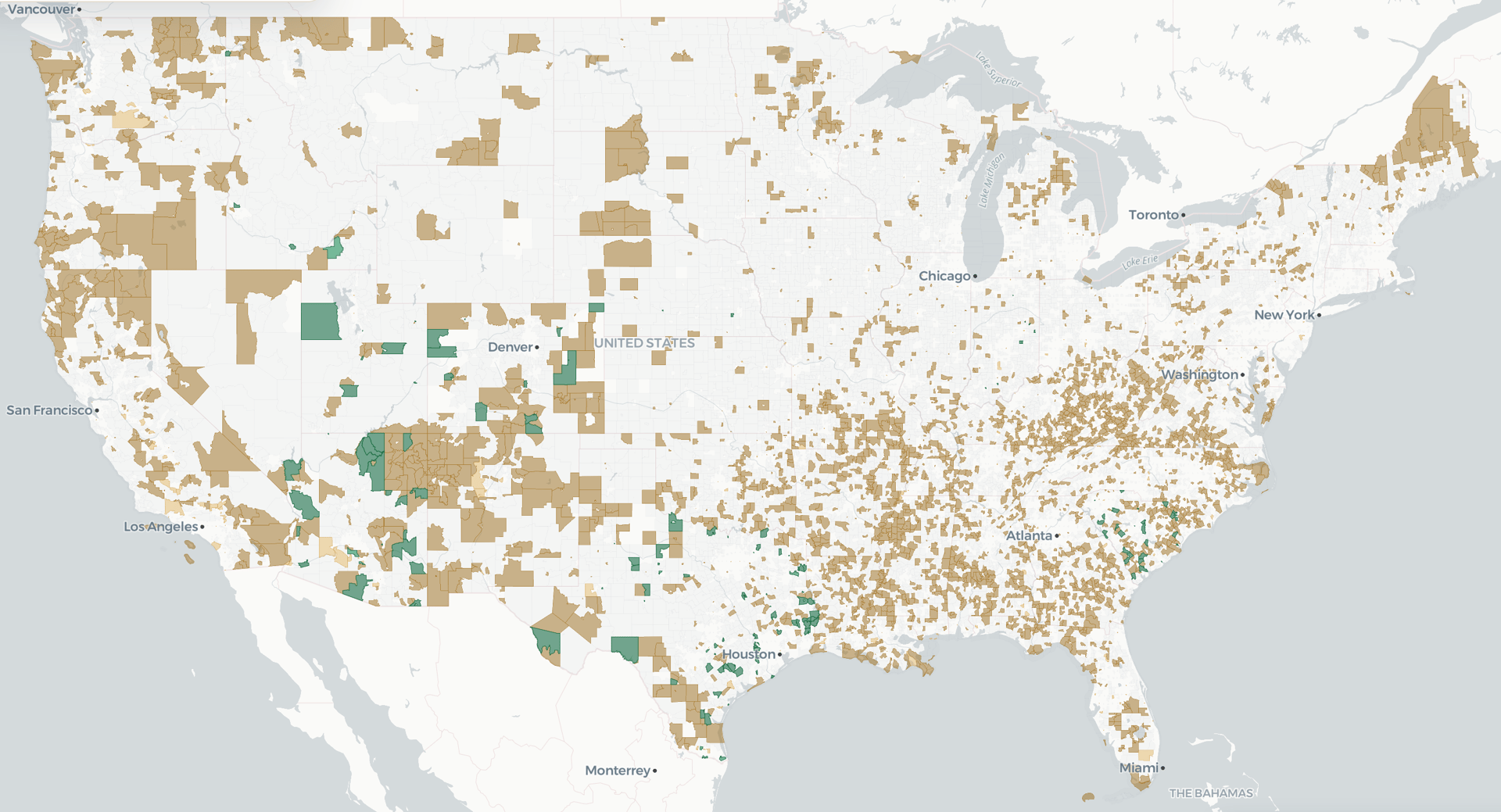
The 90-day window for governors to nominate OZ 2.0 census tracts closed on September 28, 2026, but the new Opportunity Zone map is not settled yet. At least 16 of the 56 eligible jurisdictions have submitted their nominations to the Treasury Department. Every other state and territory now has until October 28, because Treasury gave all jurisdictions an automatic 30-day extension unless they opt out.
Treasury also added 128 census tracts to the list of tracts eligible for nomination, raising nomination caps in 20 states, according to Treasury Department correspondence obtained by OpportunityZones.com. Here is where the process stands, what happens next, and when we can expect the final map of Opportunity Zones that take effect January 1, 2027.
OZ 2.0 by the numbers | As of September 28, 2026 |
|---|---|
Jurisdictions confirmed as submitted | 16 of 56 |
Tracts nominated by those 16 | 1,735 |
OZ 2.0-eligible census tracts | 25,460 (up from 25,332) |
Expected OZ 2.0 designations nationwide | 6,575 (up from 6,544) |
Extended nomination deadline | October 28, 2026 |
Latest possible certification date | December 27, 2026 |
OZ 2.0 designations take effect | January 1, 2027 |
Why the eligible list is still changing
The statute defines which census tracts count as low-income communities, but it does not say which data must be used to prove it. A tract qualifies if its median family income (MFI) does not exceed 70% of the area MFI, or if its poverty rate is at least 20% and its MFI does not exceed 125% of the area MFI.
In Rev. Proc. 2026-14, Treasury made the 2020-2024 American Community Survey (ACS) 5-year estimates the starting point. It used that survey's income and poverty figures to publish a list of 25,332 eligible tracts. But it also left the door open for other tracts, if a state could prove with other data that they meet the statutory definition.
Some states took Treasury up on that, nominating "off-list" tracts that were not on the eligible list. The results have been mixed. Some known examples:
- Texas nominated two off-list tracts in Travis County (Austin). Both have now been validated.
- Arizona nominated three off-list tracts. Treasury rejected them.
- Maine nominated four off-list tracts. Their status is pending.
Treasury's two new Alternate Frameworks, explained below, are its answer to these requests. They spell out what kinds of alternate evidence Treasury will accept. Under the first framework, Treasury ran the analysis itself and added 128 tracts to the eligible list, including Texas's two.
At least 16 jurisdictions have submitted their nominations
We have confirmed that at least 16 jurisdictions submitted OZ 2.0 nominations to Treasury on or before September 28: Alaska, Arizona, Colorado, Delaware, Idaho, Indiana, Kansas, Kentucky, Maine, Mississippi, Nebraska, North Carolina, South Carolina, Texas, the U.S. Virgin Islands and Utah. Together they nominated 1,735 census tracts, about 26% of the 6,575 OZ 2.0 designations expected nationwide.
Other states have likely submitted without announcing it publicly. We will add them to our OZ 2.0 State Tracker as they are confirmed.
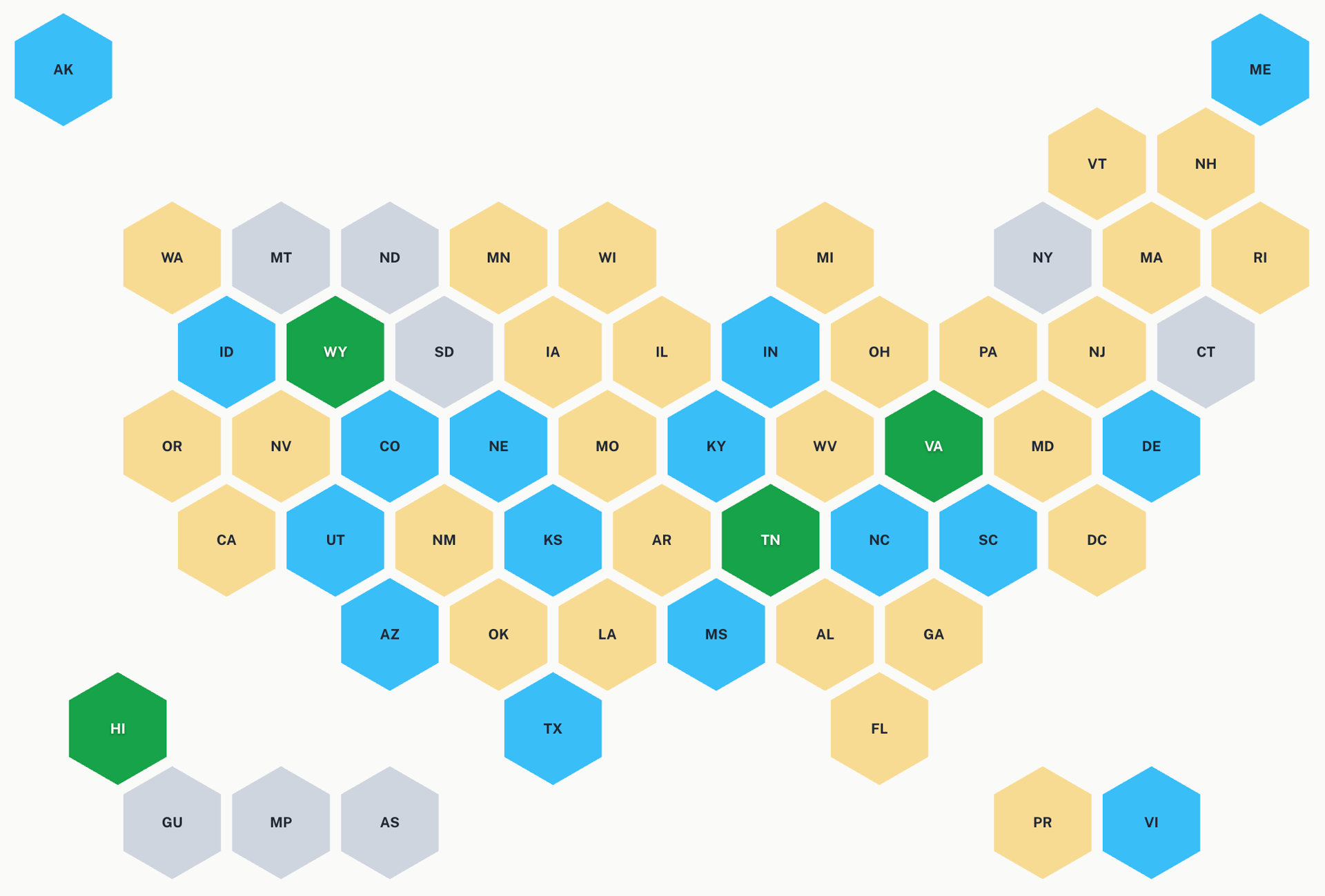
The color-coded map below indicates where each state is in the process: blue = nominations submitted to Treasury; yellow = local nomination process closed and state is determining which tracts to submit; green = local nomination process open; gray = nothing publicly known about the state's process.
Jurisdiction | OZ 1.0 zones (2018) | OZ 2.0 cap | Tracts nominated |
|---|---|---|---|
Alaska | 25 | 25 | 25† |
Arizona | 168 | 127 | 122 |
Colorado | 126 | 91 | 91 |
Delaware | 25 | 25 | 25 |
Idaho | 28 | 25 | 25 |
Indiana | 156 | 126 | 126 |
Kansas | 74 | 53 | 53† |
Kentucky | 144 | 137 | 137† |
Maine | 32 | 25 | 25† |
Mississippi | 100 | 102 | 101† |
Nebraska | 44 | 28 | 28 |
North Carolina | 252 | 204 | 202† |
South Carolina | 135 | 113 | 112 |
Texas | 628 | 608 | 608 |
U.S. Virgin Islands | 14 | 18 | 18 |
Utah | 46 | 37 | 37 |
Total | 1,997 | 1,744 | 1,735 |
† The state has announced its submission but has not yet published its full tract list. Caps include the September 28 Alternate Framework increases.
Arizona, Mississippi, North Carolina and South Carolina have nominated fewer tracts than their caps now allow. All four submitted before Treasury released the Alternate Framework, which raised their caps after the fact: Arizona from 125 to 127, Mississippi from 101 to 102, North Carolina from 202 to 204 and South Carolina from 112 to 113. It has not been confirmed whether any of them has submitted additional tracts to supplement its original list. (Arizona's confirmed submitted count is shown as 122, because in their original submission of 125 nominations, they had three off-list tract nominations which were subsequently rejected.)
Everyone else has until October 28
The 90-day determination period began on July 1, 2026 and ended on September 28. The statute lets a governor ask for more time. Under IRC Section 1400Z-1(b)(2):
"A chief executive officer of a State may request that the Secretary extend either the determination or consideration period, or both (determined without regard to this subparagraph), for an additional 30 days."
This year, Treasury granted the 30-day extension of the determination period to every jurisdiction automatically. Governors did not have to ask. A jurisdiction that does not want the extension can opt out by telling Treasury. Any state or territory that has not submitted now has until October 28, 2026.
That covers most of the map. The 16 early filers account for 1,744 of the 6,575 expected designations. The other 4,831 slots, or 73%, belong to jurisdictions that have not confirmed a submission, though some may have filed without announcing it.
Some states that have already finalized their nominations may choose to opt out, especially if the new Alternate Framework tracts do not affect them. The reason is timing. Treasury treats nominations submitted early as received on the last day of the determination period. A state that opts out is treated as filing on September 28, and Treasury's review clock starts then. A state that avails itself of the extension waits until October 28.
Under Rev. Proc. 2026-14, a state may revise its nominations as often as it likes until the determination period ends. A state that wants to use a newly eligible tract or a higher cap has 30 more days to do it.
When Treasury will certify the nominations
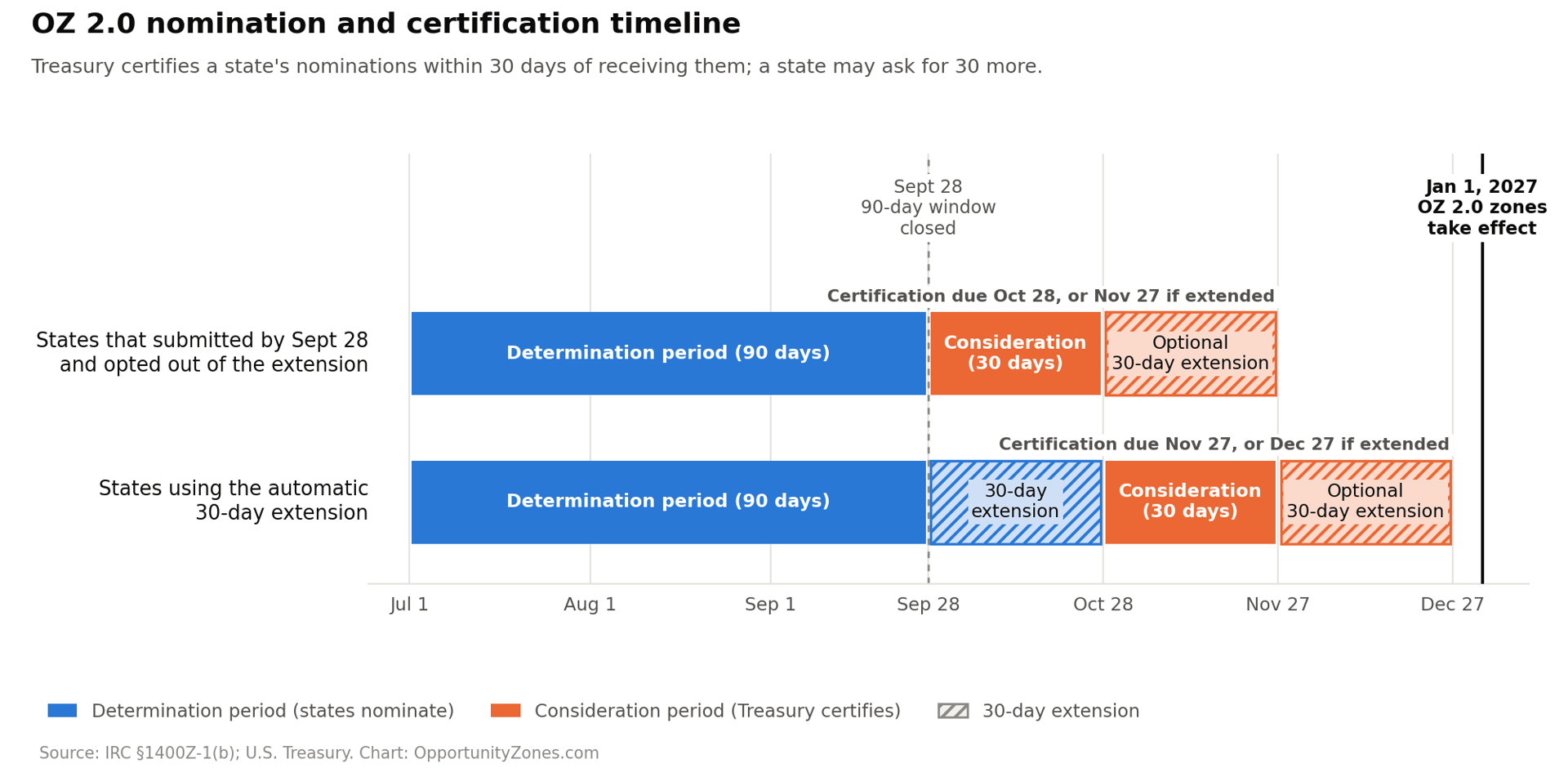
Once Treasury receives a state's nominations, the statute gives it a 30-day consideration period to certify them and designate the nominated census tracts as Opportunity Zones. A governor can ask to extend that period by another 30 days. With two possible filing dates, that creates two tracks.
Track 1: submitted by September 28, extension declined. Treasury treats these nominations as received on September 28. It has until October 28 to certify them, or until November 27 if Treasury's consideration period is extended by the statutorily optional 30-day extension. We expect this track to cover at least the 16 early filers above and likely additional states that have quietly submitted without notifying us.
Track 2: submitted by October 28 under the extension. Treasury has until November 27 to certify, or until December 27 if Treasury's consideration period is extended by the statutorily optional 30-day extension.
Date | What happens |
|---|---|
July 1, 2026 | 90-day determination period opens. |
September 28, 2026 | Original nomination deadline. Treasury's consideration period begins for early filers that submitted on or before this date and opted out of the extension. |
October 28, 2026 | Extended nomination deadline. Certification deadline for September 28 filers. |
November 27, 2026 | Certification deadline for October 28 filers, and for September 28 filers that requested an extension of Treasury's 30-day consideration period. |
December 27, 2026 | Latest possible certification, for October 28 filers that requested an extension of Treasury's 30-day consideration period. |
January 1, 2027 | OZ 2.0 designations take effect for 10 years, through December 31, 2036. |
December 31, 2028 | Original 2018 Opportunity Zone designations expire |
Either way, every OZ 2.0 designation takes effect on the same day, January 1, 2027. Treasury and the IRS have said they expect to publish a notice identifying the designated zones before then. From 2027 through 2028, the original zones and the new zones will overlap. Note: Puerto Rico's OZ 1.0 tracts expire December 31, 2027, per Rev. Proc. 2026-14.
Treasury's Alternate Frameworks automatically add 128 eligible tracts
In the final days of the determination period, Treasury notified states and other federal agencies of two Alternate Frameworks for tracts that had been left off the eligible list. Treasury has not yet published the frameworks. The details here come from its correspondence with states and other federal agencies, which OpportunityZones.com obtained. Treasury said the automatic 30-day extension exists to give governors time to decide whether the frameworks change their nominations.
Alternate Framework 1: tracts with no published median family income
Treasury recognized 128 more census tracts in 32 jurisdictions as eligible for nomination. The Census Bureau publishes no median family income (MFI) for these tracts in the 2020-2024 American Community Survey (ACS), usually because too few families were surveyed to produce a precise estimate.
So Treasury used each tract's family-income distribution (ACS Table B19101) to confirm it meets the low-income test. It finds the income bracket that contains the tract's median family. If the top of that bracket is at or below 70% of the area MFI, the tract's MFI must be too. The tract counts as a low-income community and is now marked eligible in Treasury's nomination tool.
Measure | Before | After |
|---|---|---|
OZ 2.0-eligible census tracts | 25,332 | 25,460 |
Expected OZ 2.0 designations nationwide | 6,544 | 6,575 |
2018 Opportunity Zones fully re-eligible for OZ 2.0 | 5,260 | 5,282 |
Nationally, that is a small change. But it reshapes the map at the margins in a handful of states. Many of the new tracts sit in big-city cores, including Manhattan and Brooklyn (seven tracts), Chicago's Cook County (five) and Los Angeles County (five), along with Atlanta, Charlotte, Austin and Detroit.
The new tracts also raise nomination caps in 20 states. The extra slots are not tied to the new tracts: a governor can use them on any eligible tract in the state.
State | New eligible tracts | Cap before | Cap after | Already submitted? |
|---|---|---|---|---|
New York | 14 | 426 | 429 | No |
Texas | 11 | 605 | 608 | Yes (608) |
California | 10 | 618 | 620 | No |
Ohio | 8 | 258 | 260 | No |
Florida | 7 | 340 | 342 | No |
Georgia | 7 | 236 | 238 | No |
Illinois | 7 | 238 | 240 | No |
North Carolina | 7 | 202 | 204 | Yes (202) |
Arizona | 6 | 125 | 127 | Yes (122) |
Pennsylvania | 5 | 217 | 218 | No |
Massachusetts | 4 | 103 | 104 | No |
Michigan | 4 | 214 | 215 | No |
South Carolina | 4 | 112 | 113 | Yes (112) |
Virginia | 4 | 152 | 153 | No |
Maryland | 3 | 113 | 114 | No |
Colorado | 2 | 90 | 91 | Yes (91) |
Mississippi | 2 | 101 | 102 | Yes (101) |
New Jersey | 2 | 129 | 130 | No |
Tennessee | 2 | 127 | 128 | No |
Louisiana | 1 | 155 | 156 | No |
Total | 110 | +31 |
Twelve more jurisdictions gained eligible tracts, but the additional eligible tracts did not increase their cap: the District of Columbia (three tracts); Indiana, Minnesota, Washington and Wisconsin (two each); and Alaska, Idaho, Kansas, Kentucky, New Mexico, Oklahoma and West Virginia (one each).
Six of the 20 states with higher caps had already submitted. Texas is a special case. Two of the tracts it nominated in Travis County (Austin) had been off Treasury's eligible list, and both are among the 128. Texas's 608 nominations now exactly match its new cap of 608.
The new tracts also change the outlook for some 2018 zones. Thirty of the 8,764 original Opportunity Zones overlap the 128 newly eligible tracts. Thirteen of them went from not re-eligible to fully re-eligible for OZ 2.0.
Treasury did not indicate the rural status of the 128 newly eligible tracts, but our own analysis suggests about 26 of the 128 tracts are rural, which matters for the enhanced benefits available to Qualified Rural Opportunity Funds.
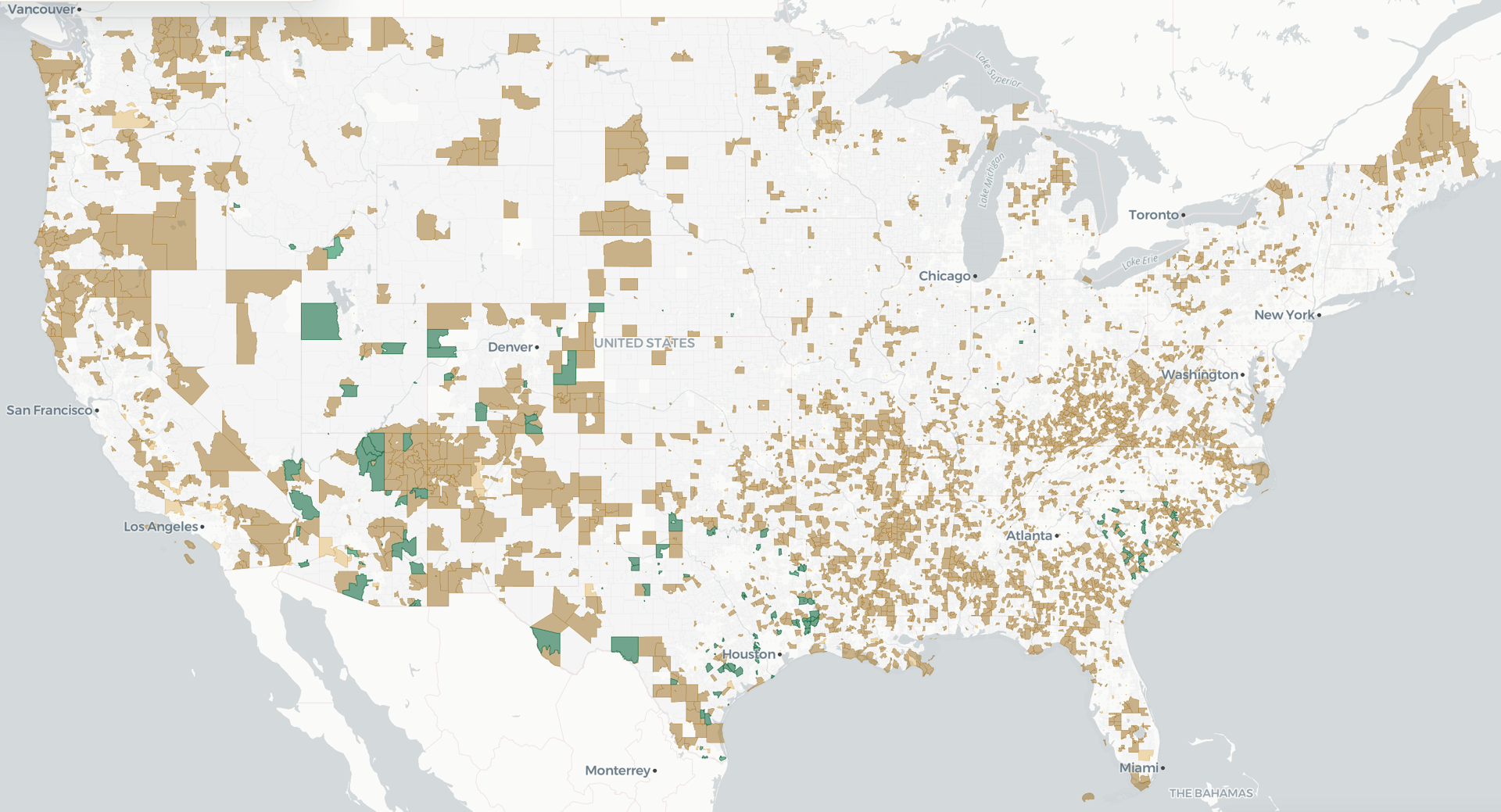
The 128 newly eligible tracts under Alternate Framework 1 are now on our national OZ map. To see only these tracts, open Advanced and tick "Alternate Framework only." Each tract's card explains why it qualifies, and our state pages flag the new tracts in each state's eligible-tract table.
Alternate Framework 2: temporary displacement after a disaster
The second framework is narrower. The ACS counts people where they are living during the survey period. After a major disaster, residents who are temporarily displaced can be counted in the tract where they are staying, not the tract they will return to. That can make a distressed tract look less poor than it is.
A jurisdiction can ask Treasury to treat such a tract as eligible if it shows three things:
- The tract met the low-income test in the most recent ACS estimate based entirely on data collected before the disaster.
- An identifiable extraordinary event caused substantial temporary displacement of residents during the ACS period.
- Reliable tract-level data show that the displaced residents differed in income or poverty in a way that made the latest ACS estimate understate poverty or overstate income.
Treasury says general economic distress, prior eligibility or a competing estimate are not enough on their own. One jurisdiction has already qualified a tract this way, using university survey data collected over the 12 months after a presidentially declared natural disaster. Treasury did not name the tract, so it does not appear on our map yet.
What it means for investors, developers and fund sponsors
- Eligible is not nominated; and nominated is not designated. Governors can nominate only 25% of their jurisdiction's eligible tracts as Opportunity Zones. There is a 25% cap exception for small states: States with fewer than 100 eligible tracts may have up to 25 census tracts designated as Opportunity Zones, unless fewer than 25 are eligible, in which case all eligible tracts are able to be designated. A tract on a governor's nomination list becomes an Opportunity Zone only when Treasury certifies the nomination. Every OZ 2.0 designation takes effect January 1, 2027.
- Most of the map can still change. Forty jurisdictions have not confirmed a submission, and their lists can change through October 28. If you are advocating for a tract, contact your state's OZ office now. Our state pages list the agency handling nominations in each state.
- Twenty states have one to three extra slots. A higher cap gives a governor room to add a tract that just missed the cut, not only one of the 128 new tracts.
- Check whether your site is in a new tract. Use the "Alternate Framework only" filter on our OZ map, or look up a single tract by address.
- The 2018 zones are not going away yet. Original designations remain in effect through December 31, 2028, so projects in those tracts have a two-year overlap with the new map. Note: Puerto Rico's OZ 1.0 tracts expire December 31, 2027, per Rev. Proc. 2026-14.
What to watch next
- Treasury's first certifications. For early filers that opted out of the extension, Treasury has until October 28 to certify, unless a state asks for more time.
- The October 28 deadline. Every jurisdiction that stayed in the extension must submit by then, including most of the largest states.
- State lists going public. Six early filers have not published their full lists, and most other states have not shared their nominations.
- Off-list decisions. Whether Treasury accepts Maine's four off-list tracts, and any others still under review.
- Treasury's notice of designated zones, expected before January 1, 2027.
- The Framework 2 tract. Treasury has not said which tract qualified under the disaster-displacement framework. (Our best guess is a tract located in Lahaina, HI, given the clues from the Treasury correspondence.)
Frequently asked questions
Was the OZ 2.0 nomination deadline September 28 or October 28?
Both. The statutory 90-day determination period ended September 28, 2026. Treasury then extended it by 30 days for every jurisdiction that did not opt out, so most states now have until October 28, 2026.
Can a state that already submitted change its nominations?
Yes, if it is still inside its determination period. Rev. Proc. 2026-14 lets a state revise its nominations until the period ends. A state that opted out of the extension has locked in its list.
When will the final OZ 2.0 map be known?
Treasury must certify all nominations by December 27, 2026 at the latest. Many will be certified sooner. Treasury and the IRS expect to publish a notice listing the designated zones before January 1, 2027.
What is an Alternate Framework tract?
It is a census tract that Treasury added to the eligible list in September 2026. Either it has no published median family income, and its income distribution shows it meets the 70% test (Framework 1), or a disaster temporarily displaced its residents during the Census survey (Framework 2).
Does the higher cap in my state mean more Opportunity Zones there?
Only if the governor uses the extra slots. A state can nominate up to its cap but is not required to fill it.
Sources and tools
- OZ 2.0 State Tracker: nomination status, caps and deadlines for all 56 jurisdictions
- OpportunityZones.com OZ map: eligible, nominated and Alternate Framework tracts
- OZ 2.0 Tract Eligibility Google Sheets file (updated with Alternate Framework 1 tracts)
- 26 U.S. Code Section 1400Z-1: designation, determination period and consideration period
- IRS: Treasury, IRS provide guidance to States for nominating census tracts (Rev. Proc. 2026-14)
- Treasury: Treasury Opens the New Designation Cycle for Opportunity Zones
- Congressional Research Service: Opportunity Zones Round Two Selection Process FAQ
- Treasury Department correspondence to states and other federal agencies on the Alternate Frameworks, September 2026 (not published by Treasury; obtained by OpportunityZones.com)